“Some of what I will tell you is fact. Some is not. But it is all true.”
The newest entry into the storied filmic history of Mary Shelly’s gothic science-fiction masterpiece, Guillermo del Toro’s Frankenstein, is a tender, big-hearted film, and one of the most successful adaptations of The Modern Prometheus to date. A passion project over thirty years in the making, Frankenstein is a technical marvel where the loving brushstroke of every artist involved in the production is clear. This is del Toro firing on all cylinders, for better or worse, and the silver screen is painted with his inimitable bold style from the first beautiful frame to the last.
A Frankenstein film directed by Guillermo del Toro seems like something that should have always existed, an undertaking that feels as natural to the maestro of the macabre as breathing oxygen is to the rest of us. With a career defined by bringing creatures to life, and making them beings with desires, humour, and struggles (see Cronos, Hellboy, Hellboy II, and The Shape of Water) it was only a matter of time before he got the chance to tackle the project he’s been dreaming about since before he knew how to direct. Frankenstein is the natural culmination of del Toro’s past ventures. It takes the styles and themes he’s been working with, and collecting, his whole career and utilises them all in a theatrical experience that feels familiar but is unlike anything released before.
Victor Frankenstein (Oscar Isaac) wants to play god. Obsessed with the line between life and death, he sets out to become master over nature and reanimate lifeless tissue. He succeeds, and the Creature (Jacob Elordi) that is born of the experiment is nothing like the egotistical perfectionist imagined him.
The two leads are fantastic. Oscar Isaac brings his best and performs a detestable Victor who isn’t beyond being worthy of compassion. He strikes the balance perfectly, and the audience’s feelings toward him fluctuate from scene to scene. Isaac isn’t a cackling, lab coat-wearing mad scientist, but a driven, self-absorbed and brilliant man who is ultimately consumed by his obsession and his creation. There is a subtle bombast to the performance. He moves like a rockstar tentatively approaching the microphone, revelling in the anticipation for the single everyone has come to hear. This veneer eventually falls away and a far more interesting Victor comes to the foreground around the midpoint of the movie. Don’t get me wrong, Victor is certainly portrayed as an antagonist (especially in that latter half), but he is a complex, well-developed character who is truer to the source material than any other adaptation has produced.
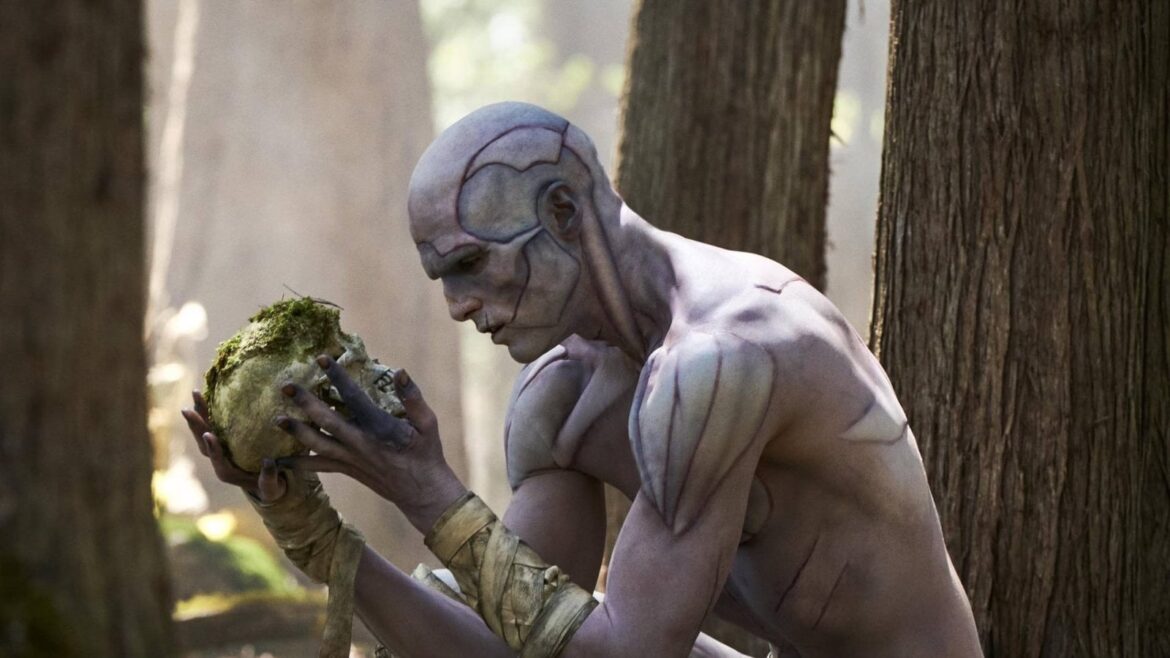
While Isaac is excellent, the true standout of the film is Jacob Elordi who, under ten hours of makeup, steals every scene as The Creature. He vanishes in the role, and at no point does his Creature look like a man under layers of grey silicone. There’s an unbelievable amount of innocence in this performance. Elordi’s eyes are bright yet blank, he looks upon the world with wonder and finds joy in the mundane. His movements are smooth yet erratic, his smile warm but unconfident and his voice is a growled whisper that shifts between soothing and threatening. This is one of the best performances of the year and Elordi makes The Creature his own, incomparable to any that have come before.
The supporting cast, too, are fantastic. Mia Goth expertly performs her dual role as Victor’s Mother, and Elizabeth. Christoph Waltz is, predictably, excellent as Harlander, a character entirely developed for the film who fund’s Victor’s experiments for his own mysterious needs. And I haven’t been able to stop thinking about Lars Mikkelson as Captain Anderson, to whom Victor and the Creature recount their tale. He’s only a minor player, but he holds so much power in every word. Charles Dance, Felix Kammerer, and David Bradley all deserve mention too. Each of them impact the leads in ways even the characters are unaware of.
The first meeting between Victor and the Creature is largely lifted from the book, and it is one of the best quietly terrifying pieces of filmmaking I’ve seen in a long time. Victor opens his eyes, and there at the foot of his bed, watching him sleep, is the creation he thought a failure. This meeting is a microcosm of the story in its entirety. Victor wraps his arms around his Adam to listen for a heartbeat, and The Creature wraps his arms around Victor to give his father a hug.
No, this is not a 1:1 recreation of the novel. Anyone hoping for that in a filmic adaptation of any work is bound to be disappointed. Del Toro takes liberties with the source material, adding or removing elements in service of the story he wants to tell. The era story has been shifted and set in 1857, rather than the late 18th century, and six years after Shelly’s own death. This change allows del Toro to both situate the narrative in a context more familiar to general audiences (people recognise the Victorian Era far more than the Enlightenment), and to allow Victor to have a grasp on technological, and medicinal innovations that would not be available during the earlier period – although, this is a story about a man reanimating a corpse, so you may think this faithfulness to historical accuracy unnecessary.
Long gone are the bolts twisted into the neck of Boris Karloff (although del Toro is a lifelong fan of the 1931 Creature, going so far as to own a giant recreation of his head that hangs in his home). They are replaced by grey patches of flesh separated by unhealing scars that divide The Creature’s body like lines on a map. The makeup work is, predictably, fantastic. The sets feel tangible and alive, the costumes are bold, and the art department (as one may imagine for a del Toro film) have worked wonders. There are several animatronic cadavers that spring to life through the film, and each of them are masterworks that combine machinery and the artist’s brush as good as, if not better, than any of the great animatronics of the past.
Guillermo del Toro’s Frankenstein is not going to work for everyone. The director takes big swings, and not all of them hit, but when they do – and they do numerous times – it makes for a great experience. This is a gothic horror epic confident in what it has to say, lovingly crafted by an expert who wears his enormous heart on his sleeve, and so full of heart itself that you’re willing to look past the flaws and love it for what it is.